See how your policies work together, or against each other.
For governments and companies, SovereignOS™ Policy Mapping reads a whole programme of policies as one system, shows where each policy helps or blocks the others, and writes the links that are missing.
Many policies are written as “ready, fire, aim” reactions to isolated instances. Others are inherited legacy burdens. Do you know if your policies are integrated and working in your favor as a system?
A tax change here, a school rule there, a housing plan somewhere else. Each can make sense alone. Together they can pull in different directions, leave gaps, or quietly cancel each other out.
Older governments and businesses carry layers of legacy policies, many still in force long after anyone remembers why. Each new set of leaders adds its own on top, rarely checking how they fit. Policy Mapping lays those layers out side by side, so you can see what to keep, what to merge and what to retire.
Policy Mapping delivers two things, whether for a government or a company. First, a single policy map: every policy placed, every intersection graded, showing where intersections exist and where they do not. Second, a roadmap of how to fix overlaps, frictions and redundancy, reduce expense, take the opportunities the map reveals, strengthen the intersections that already exist, and build what is missing where they do not.
Many tools called “policy mapping” track regulations or score compliance. Few read a whole programme as one connected system, and fewer still write the missing links. That is what we do.
Anyone with a stack of policies to connect
National governments
A clear map of how departmental policies fit, before they become law.
Governors and state governments
See how a state's budget, education, housing and justice measures interact.
Mayors and city councils
Connect local business, housing, schools and public safety into one plan.
Family offices and foundations
See which of your commitments reinforce each other, and where the gap is.
Companies
Understand how the policies around you interact before you plan around them.
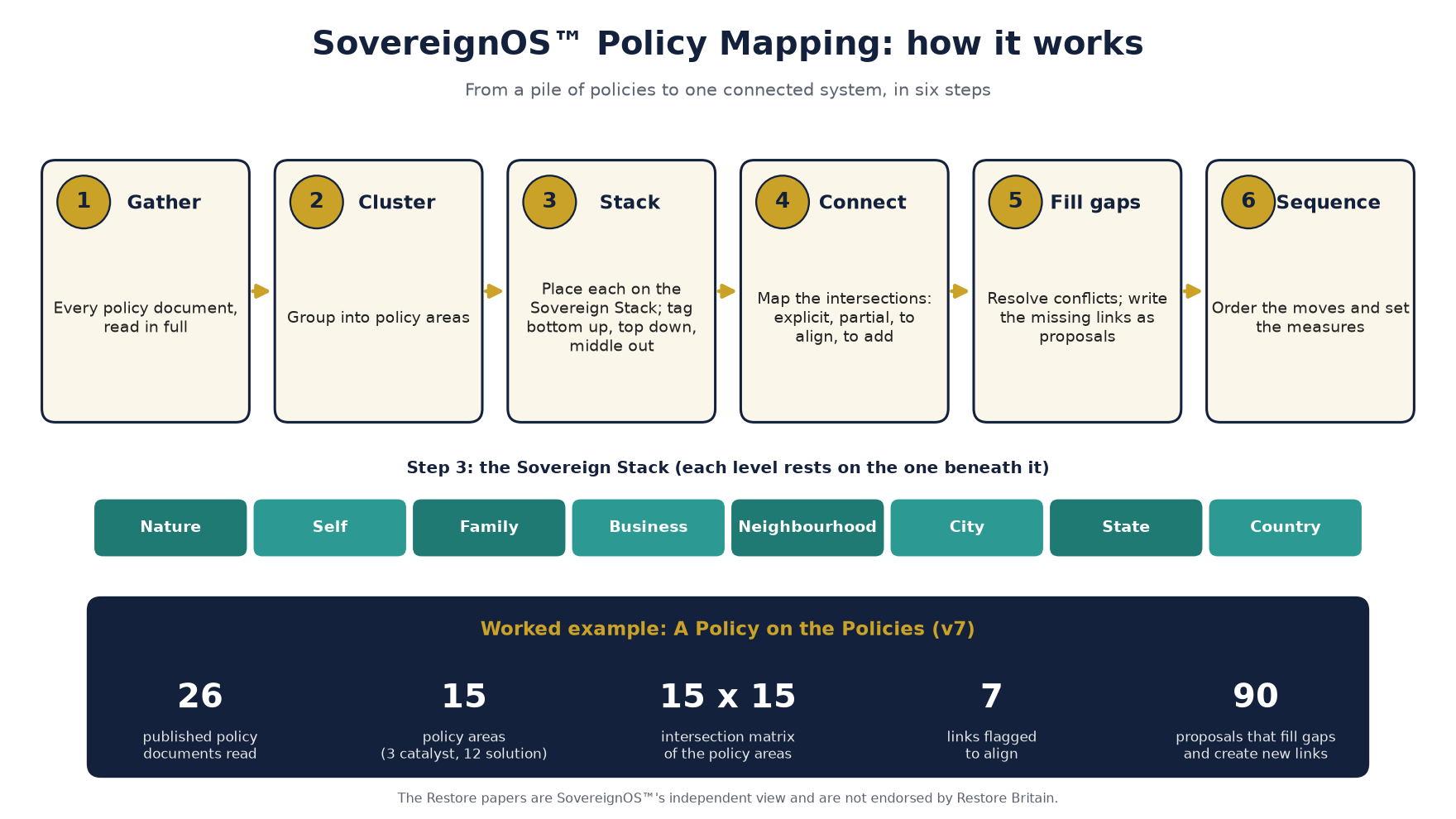
Six steps, one connected system
- 1
Gather
We collect every policy document in scope and read it in full: manifestos, papers, budgets, bills.
- 2
Cluster
We group the policies into policy areas, such as tax, education, housing and justice.
- 3
Place on the Stack
We place each measure on the Sovereign Stack, from the land and the individual up through family, business, neighbourhood, city and state to the country. We tag each as bottom up, top down or middle out, so no layer is left out.
- 4
Connect
We map the intersections between every pair of areas: where a link is explicit, where it is only implied, where two policies pull against each other, and where no link exists yet.
- 5
Fill the gaps
For each conflict or gap we write a clear proposal, stating the link it creates or strengthens.
- 6
Sequence and measure
We order the moves, so each one uses the room the one before it creates, and set measures so progress can be checked.
The Sovereign Stack: eight levels, each resting on the one beneath it
- Nature
- Self
- Family
- Business
- Neighbourhood
- City
- State
- Country
A map and a roadmap you can act on
- →A single policy map of the whole programme: every policy placed, every intersection graded, showing where intersections exist and where they do not.
- →An intersection matrix showing strong links, conflicts, overlaps, redundancy and gaps at a glance.
- →A roadmap of how to fix overlaps, frictions and redundancy; reduce expense; take the opportunities; strengthen the intersections that already exist; and build what is missing to fill the gaps.
- →Written proposals for the gaps, each marked as a proposal and showing the links it creates or strengthens.
- →A sequence: what first, what next, and why.
- →A plain-English report your team, board or cabinet can read and act on.
- →A briefing with Stuart Williams to walk you through it.
Policy Mapping is delivered by SovereignOS™ and its licensed consultants.
A Policy on the Policies
To show the method on a real programme, we mapped one in full and published the result. A Policy on the Policies reads the published programme of a UK political movement, and sets out what we found.
published policy documents read, about 730 pages in the 16 policy papers
policy areas, grouped into 3 that set the conditions and 12 that build on them
intersection matrix: every pair of areas checked
links between areas flagged as pulling in different directions, each with a proposed fix
proposals that fill the gaps, each placed on the Sovereign Stack and tagged bottom up, top down or middle out
One example of a link it created
A new link between Education and Civil Liberties, so a school system built on “how to think, not what to think” has a safeguard on both sides.
Why us
Policy Mapping sits on SovereignOS™, which was founded in 2009 and has been live-tested for 13 years of community work in Charleston, South Carolina. 450+ men have taken our free prison class to date: 74 released, none back so far.
Find the rules that are working against your business.
Your policies, incentives and regulations were written by different people at different times. Some contradict each other. Some overlap. Some leave gaps nobody owns. The cost shows up as staff turnover, audit findings, fines and strategy that stalls.
SovereignOS™ Corporate Policy Mapping delivers two things: a single policy map of how those rules work together, or against each other; and a roadmap of how to fix overlaps, frictions and redundancy, reduce expense, take the opportunities, strengthen the intersections that already exist, and build what is missing where they do not. It is the first step toward your Corporate Sovereignty Index: map first, then measure.
What your board gets
- →A single policy map: every policy, incentive and regulation placed, every intersection graded: where they exist, and where they do not
- →A roadmap: how to fix overlaps, frictions and redundancy; expense reduction; opportunities; how to strengthen the intersections that exist; and what to build to fill the gaps
- →Each finding carries a dollar-impact estimate from your own numbers
How it works
- Gather and read every policy, contract term and applicable regulation
- Group them into policy areas
- Place each on your corporate stack: employee, team, business unit, company, supply chain, community, nature, countries of operation
- Map every pair: reinforces, collides, or missing
- Propose the fixes, the strengtheners and the missing links
- Sequence them and set the measures
AI-assisted, consultant-led: AI does the heavy reading and first cross-check. A licensed SovereignOS™ consultant reviews every finding, and every claim cites your own documents. Your information stays confidential.
See the method on a real programme: the Policy on the Policies, 15 policy areas, 90 proposals (SovereignOS™'s independent view).
Fees follow the SovereignOS™ consulting fee schedule.
Want your policies mapped?
Book a private 30-minute briefing with Stuart Williams, or write to info@sovereignos.world.
We use cookies to run this site and understand how it's used. Privacy Policy