Sovereignty in Education
Putting sovereignty, heritage, and meritocracy back in school — from 3rd grade through college.
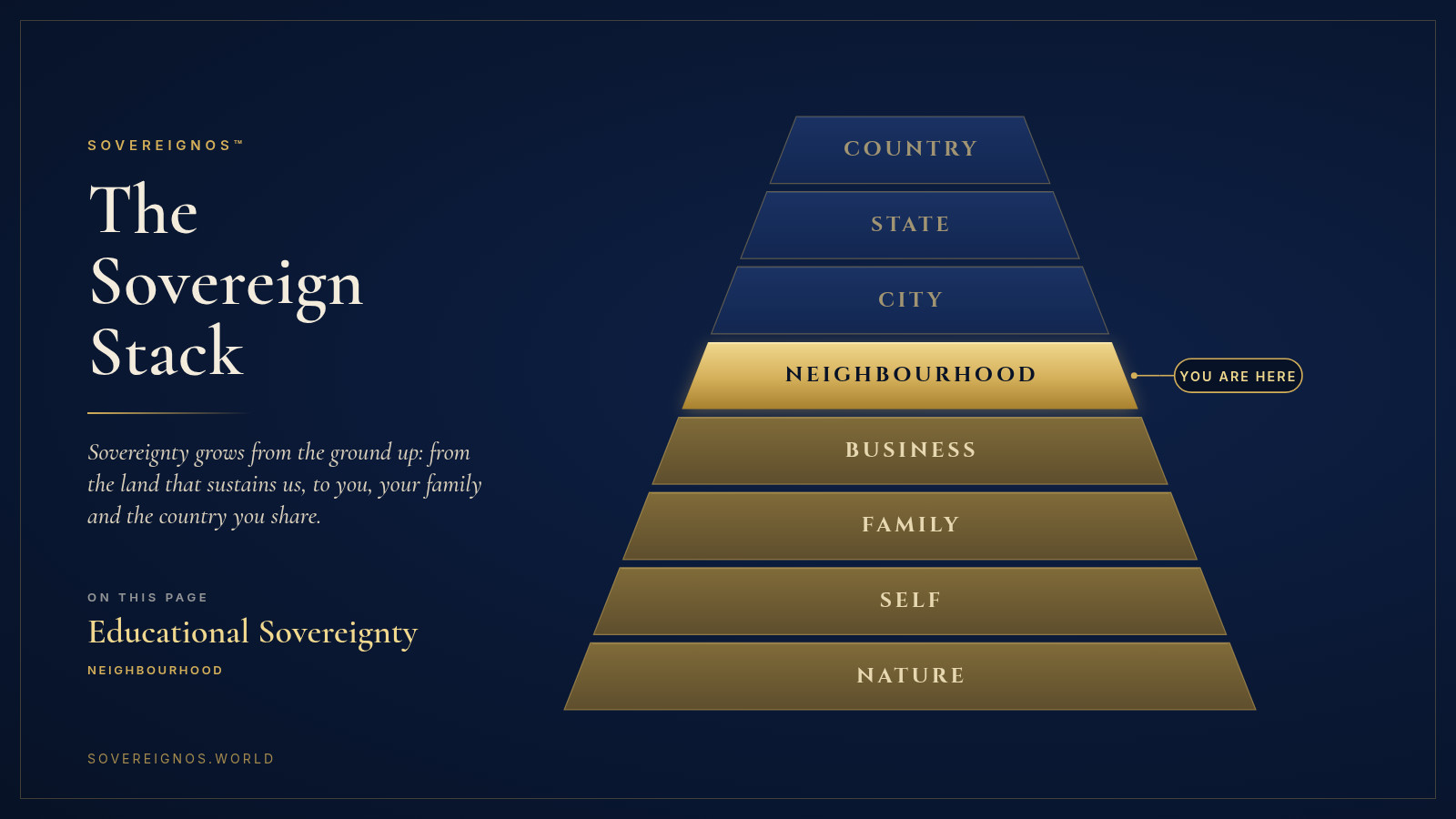
The Sovereign Stack
Sovereignty is not handed down from the top. It is built from the ground up. A sovereign stack rests on nature, the land that sustains us, and rises through the self, the family, business, neighbourhood, city and state to the country we share. True sovereignty at any level is not achievable unless every level beneath it is strong. The foundation must hold before the next level can stand, and once a level is lit, it works hard to light the ones above. A nation or state is only as sovereign as its land, people, families, businesses and communities.
Education is where the stack renews itself. The neighbourhood school, library and youth programme are often the first institutions a child meets beyond the family, and they shape the citizens every higher level will rely on. Educational sovereignty means families and communities have a real say in what and how their children learn. A people that can think, question and build for itself is the surest foundation any state or nation can have.
Transforming 3rd Through 12th Grade Education
Making College Worth It Again
The System Is Failing Students
The traditional K–12 education model is facing a systemic breakdown. Despite historic levels of per-pupil spending, schools are trapped in an administrative loop that prioritizes standardized testing over real-world capability.
The baseline reality of today's educational landscape reveals stark inefficiencies:
The Literacy Gap
Roughly 40% of fourth-graders score below the "basic" level in reading, marking some of the lowest proficiency baselines seen in decades.
The Math Deficit
Only about 27% of eighth-graders meet or exceed the national standard for proficiency in mathematics — a staggering indicator of systemic decline.
The Readiness Illusion
While national high school graduation rates hover around 87%, millions of students graduate with a diploma that represents little more than "time served." Without immediate intervention, we continue to channel young adults directly from high school into a cycle of unmet need or the welfare system.
Sovereignty for Education by SovereignOS™ fundamentally solves this problem. We replace systemic failure with Consequential Learning™—equipping students with autonomy, purpose, and real economic capability.
The "Innovate to Graduate" Syllabus
Developed by Ms. Jenny Whittle, the Innovate to Graduate syllabus is a masterpiece of experiential, Consequential Learning™. It completely bypasses rote memorization and political administration. It doesn't teach children what to think; it teaches them how to become innovative problem solvers.
Starting as early as the 3rd grade and building progressively through the 12th grade, this curriculum transforms the classroom. By the time students graduate, they have researched, built, tested, and launched profit-for-purpose companies right inside their local communities.
Every single business they build is specifically designed to solve a local socioeconomic or environmental problem.
"Innovation does not wear a tie or a string of pearls; it wears lived experiences."
Instead of leaving high school unprepared for the real world, these students emerge as highly contributing assets to society—ready to dominate the workforce or hit the ground running in higher education.
The ImpactX Phenomenon
SovereignOS™ does not stop at the 12th grade. Our framework expands seamlessly into higher education.
In 2013, the founder of SovereignOS™ designed, helped fund, and for 11 years helped teach the award-winning ImpactX Class at the College of Charleston—the very foundation upon which the K–12 syllabus was built.
ImpactX has completely redefined entrepreneurial education:
Massive Demand
The program has been so widely successful that it has expanded from a single course to 5 distinct classes.
Institutional Catalyst
It served as the direct catalyst for the college creating its brand-new Major in Entrepreneurship.
Unmatched ROI
ImpactX graduates are highly sought after by top-tier employers, routinely getting hired well before their peers, with an average starting salary that is 11% higher than the baseline university average.
Reclaim Your Educational Sovereignty
This is the pinnacle of human-centered, Consequential Learning™. SovereignOS™ gives school boards, administrators, professors, teachers, and students the power to take back their educational sovereignty and autonomy.
When you teach students how to create tangible, real-world value, you produce sustainable prosperity that drives economic vibrancy wherever those students choose to live.
Why education is an economic sovereignty issue
South Carolina's own numbers make the case. A new report from the South Carolina Department of Education and the University of South Carolina's Darla Moore School of Business (October 2026) links student achievement directly to the state's economic future:
- Up to $207.9 billion. If 75% of students met grade-level expectations, the state could see "up to $162.1 million in additional earnings per cohort per year and up to $207.9 billion in economic activity cumulatively over 35 years."
- Every point counts. Each one-point rise in proficiency is worth "up to $5.3 million in additional annual earnings per graduating cohort and up to $6.7 billion in cumulative statewide economic activity over approximately 35 years."
- The gap is real. In 2025, 59.6% of South Carolina students met or exceeded expectations in English and 43.9% in math.
- Progress pays. This year's roughly four-point gain in math alone is worth "approximately $21.2 million in additional direct annual earnings" for that cohort.
- The path pays. In South Carolina, a high school diploma brings about 25 percent higher median earnings than no diploma, and a bachelor's degree about 109 percent (US Census ACS 2024, as cited in the report).
It starts in 3rd grade. The state measures achievement from grade 3, and so does Innovate to Graduate™, SovereignOS™'s education track for grades 3–12. It teaches students how to think, not what to think, and takes them all the way to market.
Source: Joseph Von Nessen, Ph.D., "The Economic Impact of Improving Student Performance in South Carolina," released Oct 27, 2026 by the SC Department of Education and the USC Darla Moore School of Business. Read the release. SovereignOS™ is independent and not affiliated with or endorsed by SCDE or USC.
We use cookies to run this site and understand how it's used. Privacy Policy